50 Years Ago: Government Stops Investigating UFOs - National Archives Foundation
To mark the 50th anniversary of the end of Project Blue Book, the National Archives will display records from the […]
· archived 5/21/2026, 2:59:14 AMscreenshotcached html 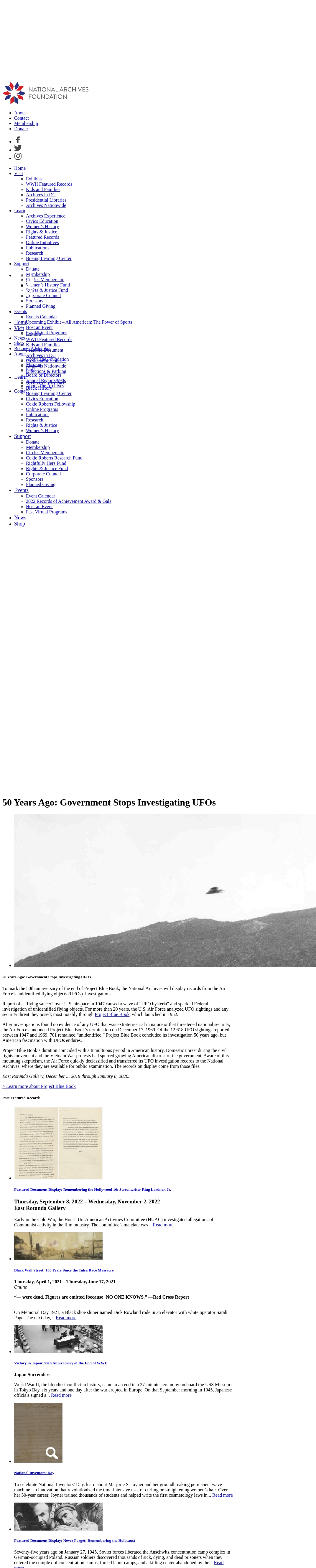 HomeDocuments50 Years Ago: Government Stops Investigating UFOs 50 Years Ago: Government Stops Investigating UFOs To mark the 50th anniversary of the end of Project Blue Book, the National Archives will display records from the Air Force’s unidentified flying objects (UFOs) investigations. Report of a “flying saucer” over U.S. airspace in 1947 caused a wave of “UFO hysteria” and sparked Federal investigation of unidentified flying objects. For more than 20 years, the U.S. Air Force analyzed UFO sightings and any security threat they posed; most notably through Project Blue Book, which launched in 1952. After investigations found no evidence of any UFO that was extraterrestrial in nature or that threatened national security, the Air Force announced Project Blue Book’s termination on December 17, 1969. Of the 12,618 UFO sightings reported between 1947 and 1969, 701 remained “unidentified.” Project Blue Book concluded its investigation 50 years ago, but American fascination with UFOs endures. Project Blue Book’s duration coincided with a tumultuous period in American history. Domestic unrest during the civil rights movement and the Vietnam War protests had spurred growing American distrust of the government. Aware of this mounting skepticism, the Air Force quickly declassified and transferred its UFO investigation records to the National Archives, where they are available for public examination. The records on display come from those files. East Rotunda Gallery, December 5, 2019 through January 8, 2020. > Learn more about Project Blue Book Past Featured Records Spymaster-in-Chief: George Washington’s Wartime Espionage During the Revolutionary War, a large network of colonial spies worked in secret to disrupt British forces. When George Washington took command of the Continental Army in July 1775, he strengthened intelligence efforts by planting false information and writing coded letters to gain an edge over the larger and more experienced British Army. Washington’s account book of wartime spending reveals information about these secret operations. Read More Snapshots of Service: The 250th Anniversary of the U.S. Navy The U.S. Navy’s long history began on October 13, 1775, when the Continental Congress authorized ships to intercept British transports as war intensified. While the Navy’s early years are preserved in muster rolls, deck logs, and service records, the Civil War saw photography more candidly capture life in the service. Read More Constitution Day: The Full U.S. Constitution Now Extended! On display 9/16/25 – 10/9/25 For the first time in history, the entire United States Constitution is on display, celebrating 250 years of American Freedom. In celebration of 250 years of American Freedom, the entire U.S. Constitution and the original Bill of Rights is surrounded by 17 Constitutional amendments, filling the Rotunda at the National Archives in ... Read More 80 Years Since the End of World War II World War II, the deadliest military conflict in history, ended six years and one day after the war erupted in Europe. On September 2, 1945, just four months after Nazi Germany’s surrender, Japanese officials issued an imperial order and signed a formal surrender ending hostilities in the Pacific Theater. Read More To the Polls: 60 Years of the Voting Rights Act In the 1960s, voting rights were at the forefront of many Americans’ minds. Nearly 100 years had passed since the 15th Amendment outlawed voting restrictions “on account of race, color, or previous condition of servitude.” But threats of violence, literacy tests, and extra fees still prevented many Black voters from exercising their constitutional right at the polls. Read More
 TextSearch